


Key Takeaways
- Lenders assign interest rates based largely on credit score tiers, not a single universal rate.
- A difference of 100 points in your score can mean hundreds or thousands of dollars in extra interest over a loan term.
- Checking your credit report for errors before applying costs nothing and can prevent an unfair rate.
- Pre-approval from multiple lenders lets you compare rates without committing to any one offer.
- Improving your score even modestly before applying can move you into a lower rate tier.
- This article provides general financial education, not personalized advice; consult a licensed financial professional for decisions specific to your situation.
Credit score and auto loan rate
A credit score is a three-digit number, typically ranging from 300 to 850, that summarizes your history of borrowing and repaying debt. Lenders use it to estimate how likely you are to repay a new loan on time. The higher your score, the lower the interest rate a lender is generally willing to offer, because a high score signals lower risk. A lower score usually means a higher rate, which translates directly into more money paid over the life of the loan.
Most auto lenders rely on FICO scores, though some use VantageScore. The scoring model and which credit bureau's data is pulled can produce slightly different numbers, so checking all three bureaus (Equifax, Experian, TransUnion) before applying is worth doing.
How lenders translate your score into a rate
When you apply for an auto loan, the lender pulls your credit score and places you into a risk tier. Each tier corresponds to a rate range the lender is willing to offer. The tiers go by different names across lenders, but the logic is consistent: lower risk gets a lower rate.
A common way to think about the tiers is by score band. Borrowers with scores above roughly 720 are often categorized as prime or super-prime and receive the rates closest to what lenders advertise. Scores in the 660-719 range typically land in a mid-tier with moderate rates. Scores below 600 are often classified as subprime, and the rates in that tier are meaningfully higher to compensate the lender for the added risk.
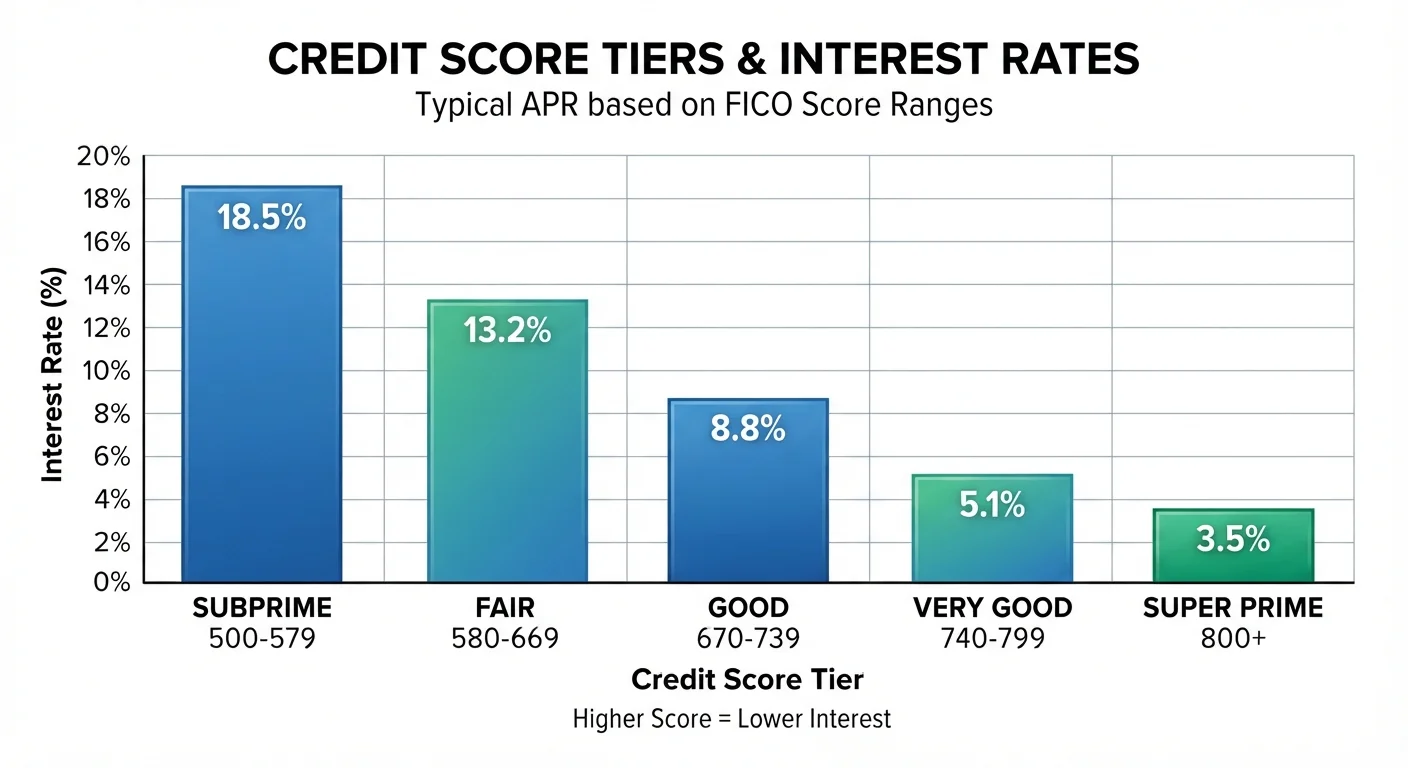
Your score is not the only input. Lenders also consider your debt-to-income ratio, employment history, and how much you are borrowing relative to the vehicle's value (called the loan-to-value ratio). But for most borrowers, the credit score is the single variable with the most immediate influence on the rate offered. See how to read the key numbers in a loan offer once you have a rate in hand.
Why a small score difference can cost thousands
Auto loan rates are not adjusted a few cents at a time. Lenders move borrowers between tiers with distinct rate bands, so crossing a score threshold can shift your rate by one to three percentage points at once.
$3,300+
Extra interest on a $25,000 loan at 10% vs. 5%
Calculated over a 60-month term; actual figures depend on lender rates and loan terms.
300-850
FICO score range used by most auto lenders
FICO is the scoring model most commonly used in auto lending decisions in the United States.
720+
Score often needed for prime rate offers
Borrowers above this threshold generally qualify for the most competitive rate tiers, though cutoffs vary by lender.
On a $25,000 loan over 60 months, the difference between a 5% rate and a 10% rate is roughly $3,300 in total interest. On a longer loan or a larger vehicle purchase, the gap widens further. This is why small differences in score, even 20 or 30 points, can move a borrower from one tier to another and change the total cost of the loan materially.
For anyone considering a used vehicle, the same mechanics apply. Used car financing sometimes carries higher base rates than new car loans, so the credit score tier has an even larger dollar impact in that context.
Steps you can take before applying
Pulling your credit reports from all three bureaus before applying gives you a chance to spot errors. Incorrect late payments, accounts that are not yours, or balances reported higher than they actually are can all suppress your score. Disputing errors through the bureau's process is free and can improve your score before a lender ever sees it.
Paying down revolving credit (credit cards) to below 30% of the credit limit is one of the faster ways to lift a score. Payment history carries the most weight in most scoring models, so any accounts currently past due should be brought current first.
Rate-shop within a short window
Applying to multiple lenders within 14 to 45 days (the window varies by scoring model) groups your auto loan inquiries into one. This lets you collect several real rate offers without meaningfully lowering your score. Aim to complete all applications within that window, then compare the full terms, not just the monthly payment.
Getting pre-approved by two or more lenders before committing to a loan lets you see real rate offers, not estimates. Multiple auto loan inquiries within a 14-to-45-day window are typically grouped as a single inquiry by major scoring models, so rate shopping in a short period carries minimal score impact. Common misconceptions about car loans can lead borrowers to skip this step, which sometimes results in accepting a higher rate than necessary.
If your score is lower than you would like, refinancing later once your score has improved is an option worth understanding before you sign the original loan agreement.
This article is for general informational purposes only and does not constitute personalized financial or legal advice. Loan terms, rates, and eligibility vary by lender. Consult a licensed financial professional before making decisions specific to your situation.