

Key Takeaways
- PIP is mandatory in most no-fault states; MedPay is optional almost everywhere.
- PIP covers more than medical bills, including lost wages and certain household services.
- MedPay applies only to medical and funeral expenses, with no wage or service component.
- Both coverages pay regardless of who caused the accident.
- Coverage limits, availability, and required minimums vary by state.
- Neither coverage replaces liability insurance or covers vehicle damage.
Option A
Personal Injury Protection (PIP)
The broader medical coverage required in no-fault states.
Best for: Drivers in no-fault states who want coverage for lost wages, household services, and medical costs regardless of fault.
Option B
Medical Payments Coverage (MedPay)
A simpler, narrower add-on for medical bills after an accident.
Best for: Drivers in at-fault states who want a straightforward way to cover immediate medical expenses for themselves and passengers.
If you live in a no-fault state
Personal Injury Protection (PIP)
Your state likely requires PIP, and its broader scope covers lost income and related costs that MedPay does not address.
If you want a simple medical add-on in an at-fault state
Medical Payments Coverage (MedPay)
MedPay is widely available, straightforward to use, and fills gaps in health insurance deductibles after an accident.
If you have strong employer disability coverage and health insurance
Medical Payments Coverage (MedPay)
Because your other policies handle lost wages and most medical bills, MedPay's narrower scope may be sufficient and cost less.
What each coverage is designed to do
Personal Injury Protection, usually called PIP, and Medical Payments Coverage, usually called MedPay, both pay for medical costs that arise from a car accident. That shared purpose leads many drivers to treat them as interchangeable, but the two coverages differ in what they pay for, where they are available, and whether they are optional.
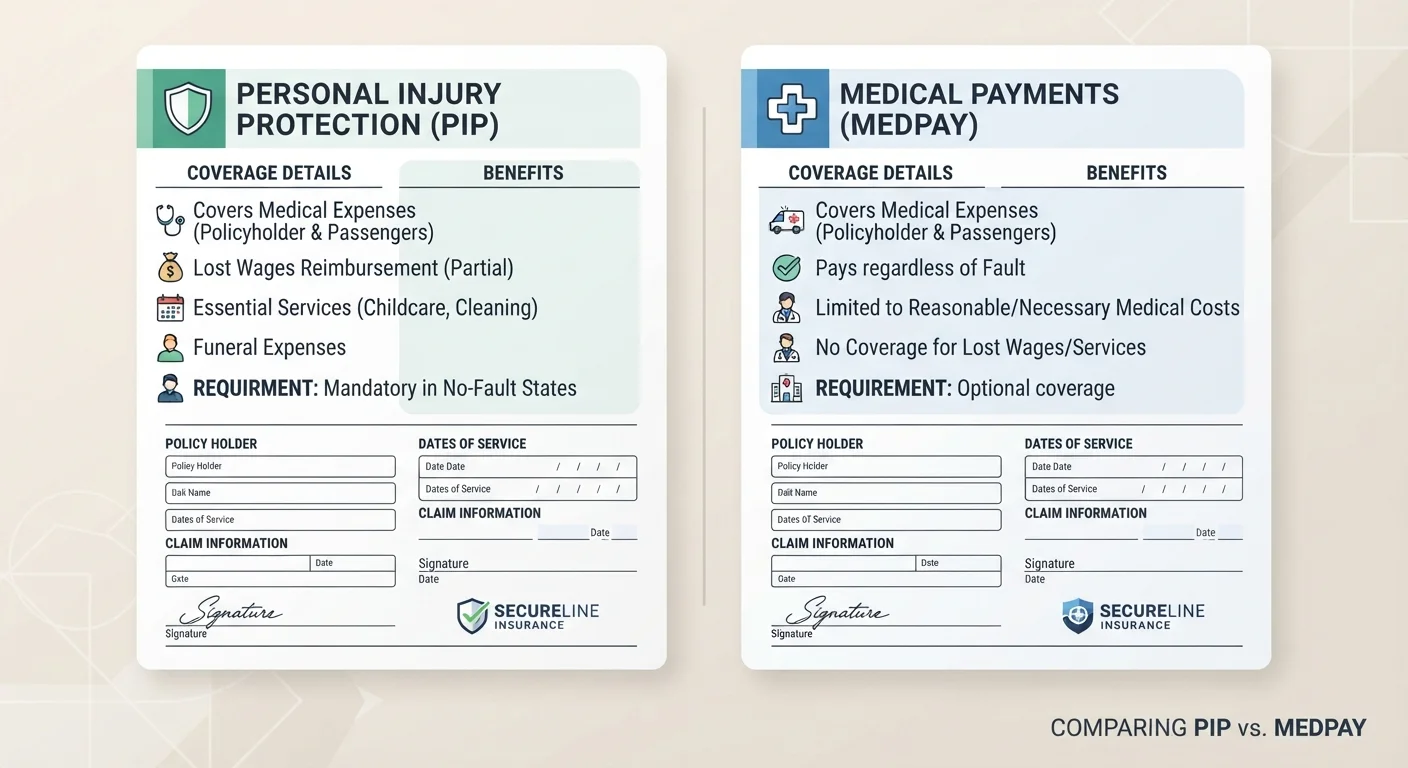
PIP is the broader coverage. In addition to medical and hospital bills, it can reimburse lost wages when an injury keeps you from working, cover the cost of services you can no longer perform yourself such as childcare or housekeeping, and in some states pay funeral expenses. PIP is mandatory in states that follow a no-fault insurance system, where each driver's own policy pays their medical costs regardless of who caused the crash. About a dozen states require PIP by law, and several others make it available as an option.
MedPay is narrower. It covers reasonable medical and funeral expenses for you and any passengers in your vehicle, and it also applies if you are injured as a pedestrian or while riding in someone else's car. MedPay does not cover lost wages or household services. It is an optional add-on in most states, and a handful of states do not offer it at all.
Both coverages pay without regard to fault, which means you do not have to wait for liability disputes to settle before your medical bills are addressed. For a broader look at how these coverages fit into a full policy, see the overview of standard auto policy coverage types.
How the two coverages compare directly
The table below lays out the main differences across common comparison points.
| Criterion | PIP | MedPay |
|---|---|---|
| Covers medical expenses | Yes | Yes |
| Covers lost wages | Yes | No |
| Covers household services | Yes, in most states | No |
| Covers funeral expenses | Yes | Yes |
| Pays regardless of fault | Yes | Yes |
| Required by law | Yes, in no-fault states | No, optional in most states |
| Availability | Required or available in select states | Optional in most at-fault states |
One detail worth noting: in states that require PIP, MedPay may still be purchased as a supplement, though the practical benefit depends on your existing PIP limits and health insurance situation. Drivers who carry high-deductible health plans sometimes find MedPay useful for covering out-of-pocket costs that health insurance does not pay immediately after an accident.
State rules and availability
Where you live determines which of these coverages you can buy and whether you have a choice at all. No-fault states such as Florida, Michigan, New York, and New Jersey require drivers to carry PIP at set minimum limits. Those minimums vary: Florida requires $10,000 in PIP coverage, while Michigan uses a different tiered structure. Because state laws change, always confirm current requirements with your state's department of insurance or a licensed agent.
In at-fault states, neither PIP nor MedPay is typically required. MedPay is the more commonly available option in those states, while PIP may be offered in a limited form or not at all.
If you are new to understanding how coverage requirements work by state, the article on state minimum coverage gaps explains what mandatory minimums do and do not protect.
No-fault rules and subrogation
In no-fault states, your PIP coverage pays your medical costs first, and your ability to sue the other driver for damages may be limited unless your injuries meet a threshold set by state law. MedPay in at-fault states typically allows your insurer to seek reimbursement from the at-fault driver's liability coverage after paying your claim, a process called subrogation. Ask your agent how these rules apply in your state.
Deciding whether you need one, both, or neither
If your state mandates PIP, the decision is largely made for you. The remaining question is whether to buy above the minimum limit, which depends on your health insurance, whether you are self-employed, and how much income you would lose if you could not work after an accident.
In at-fault states where MedPay is optional, consider the deductible and out-of-pocket maximum on your health plan. MedPay limits commonly run from $1,000 to $10,000. A modest MedPay limit can cover ambulance fees, emergency room copays, and follow-up visits that health insurance requires you to pay first.
Neither coverage is a substitute for liability insurance, which protects other people when you cause an accident. For a full picture of how all these pieces connect, the beginner's walkthrough to auto insurance is a useful starting point.
This article is for general informational purposes only and is not personalized insurance, financial, or legal advice. Coverage terms, limits, exclusions, and state requirements vary by provider and location. Read your policy documents carefully and consult a licensed insurance agent for guidance specific to your situation.