

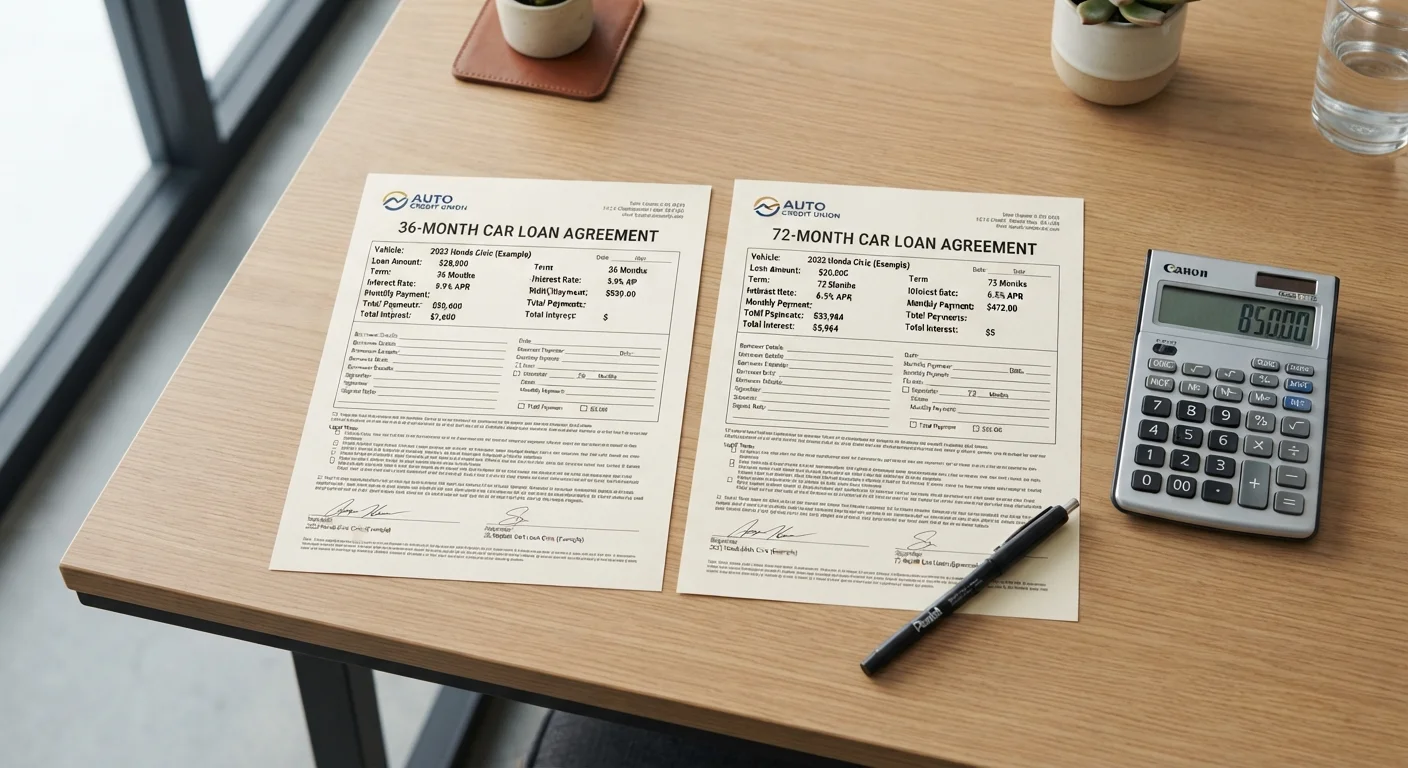
Key Takeaways
- A shorter loan term means higher monthly payments but less total interest paid over the life of the loan.
- A longer loan term lowers monthly payments but increases the total cost of the vehicle.
- With longer terms, borrowers risk becoming "underwater" - owing more than the car is worth.
- APR and loan term work together: a low rate on a long term can still cost more than a higher rate on a short term.
- Always compare total cost, not just monthly payment, when evaluating loan offers.
Option A
Short-term auto loan (36 months)
The faster payoff with lower total interest cost.
Best for: Borrowers who can manage higher monthly payments and want to minimize total interest paid.
Option B
Long-term auto loan (72 months)
The lower monthly payment spread over more time.
Best for: Borrowers who need smaller monthly payments to fit a tight monthly budget.
If you can afford a higher monthly payment
Short-term auto loan (36 months)
You will pay significantly less in total interest and own the vehicle outright sooner, reducing financial exposure.
If monthly cash flow is your primary constraint
Long-term auto loan (72 months)
Lower monthly payments free up room in your budget, though you should plan for higher total interest and depreciation risk.
If you plan to trade in or sell within a few years
Short-term auto loan (36 months)
A shorter term reduces the chance of owing more on the loan than the car is worth when you sell.
How loan term affects what you actually pay
An auto loan term is the number of months you have to repay the debt. Common terms run from 24 to 84 months, but 36-month and 72-month loans illustrate the tradeoff clearly. The term affects two numbers that work in opposite directions: your monthly payment and the total interest you pay.
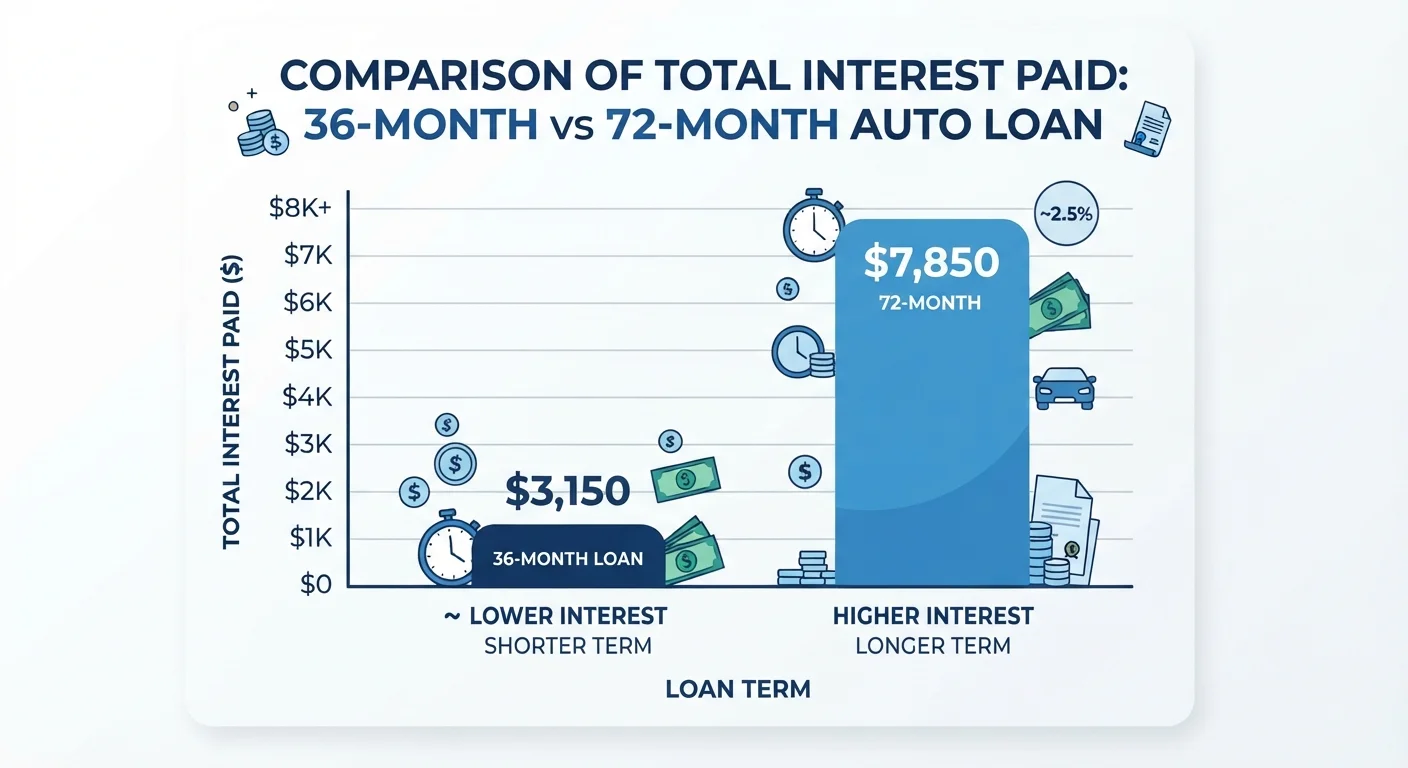
Consider a $25,000 loan at a fixed 7% APR (annual percentage rate, the yearly cost of borrowing including fees). At 36 months, the monthly payment comes to roughly $772, and total interest paid over the life of the loan is approximately $2,800. Stretch that same loan to 72 months and the monthly payment drops to about $480, but total interest climbs to around $5,600 - nearly double. The math holds across loan sizes: longer terms cost more in interest, period.
Reading an auto loan offer explains how APR and fees combine in a financing agreement, which helps when comparing real offers side by side.
The depreciation problem with long terms
Vehicles lose value quickly. A new car can drop 15% to 20% in value within its first year. A used car depreciates more slowly but still loses value over time. When a loan term extends well past the period of sharpest depreciation, borrowers risk going "underwater," meaning they owe more on the loan than the car is worth.
Being underwater matters when life changes, such as a job loss, accident, or decision to sell. If your car is worth $14,000 but you still owe $17,000, selling it requires paying the $3,000 gap out of pocket. Gap insurance (guaranteed asset protection insurance) can cover this difference in a total loss, but it adds to borrowing costs and is not a substitute for choosing a term that matches the vehicle's likely value curve.
Used car financing explained covers how depreciation interacts with loan structure for used vehicle purchases specifically.
Gap insurance and loan term
Gap insurance covers the difference between what you owe on a loan and what your insurer pays if the car is totaled or stolen. It is most relevant on long-term loans where depreciation outpaces loan paydown. Coverage terms and costs vary by provider; read the policy document carefully and consult a licensed insurance agent to determine whether it fits your situation.
Comparing the two terms across key criteria
The table below uses consistent assumptions to show how term length changes each factor. Actual figures vary with credit score, lender, vehicle age, and loan amount.
| Criterion | 36-month loan | 72-month loan |
|---|---|---|
| Monthly payment (on $25,000 at 7% APR) | ~$772 | ~$480 |
| Total interest paid | ~$2,800 | ~$5,600 |
| Total repayment amount | ~$27,800 | ~$30,600 |
| Underwater risk | Lower | Higher |
| Time to full ownership | 3 years | 6 years |
| Monthly budget pressure | Higher | Lower |
Auto loan myths that cost borrowers money addresses the common belief that monthly payment is the only number worth watching, which the table above directly contradicts.
When the longer term makes sense anyway
A 72-month loan is not automatically a mistake. If the choice is between a loan you can sustain and one that strains your budget every month, the more manageable payment has real value. Missed or late payments damage credit scores and can lead to repossession, which costs far more than extra interest.
Some borrowers take a longer term deliberately, then make extra principal payments when cash allows. This can reduce total interest while preserving the flexibility of a lower required payment. Before doing this, check the loan agreement for prepayment penalties. Paying off a car loan early walks through what to verify before sending extra money to the lender.
This content is general financial information for educational purposes and is not personalized financial advice. For guidance on your specific situation, consult a licensed financial adviser or credit counselor.
This article is for informational purposes only and does not constitute financial, legal, or lending advice. Loan terms, rates, and costs vary by lender, credit profile, and vehicle. Consult a qualified financial professional before making borrowing decisions.